


Construction Safety on Small Sites: What Actually Works | Sisco Profiles

Updated: 5 days ago
Construction Safety on Small Sites: What Actually Works
Most fatal falls on a construction site happen from under 10 feet. Not off a crane, not off a scaffold edge everyone already treats with caution. That fact is worth sitting with for a moment, because it tells you something about where safety actually breaks down — not at the obvious risks, but at the ones nobody marks because the job is only two weeks long.
We shared some thoughts on this on LinkedIn recently. The response made it clear this is something a lot of people in construction are thinking about but not necessarily talking about on site. So here's the longer version.
The pattern most SME sites follow
Safety gets reserved for the things that look dangerous. The crane. The scaffold at the fourth floor. The excavation pit everyone can see. The things that already make workers stop and think.
What doesn't get treated as a risk: the plank someone stands on for twenty minutes to level a false ceiling. The stairwell opening nobody fenced because the RCC floor was poured last week and "everyone knows it's there." The wet floor at the base of a ladder because the plumber ran pipe through that area this morning. The electrician working without shoes because it's hot and nobody said anything.
These are the real accident sites. And on most small commercial projects in Gujarat — or anywhere in India — nobody has written them down, assigned them to anyone, or talked about them before the shift started.
What doesn't actually work
The safety register that gets signed at the start of the job and never opened again. PPE issued on day one and assumed to be worn thereafter. A safety poster on the hoarding that nobody looks at. A WhatsApp message from the site engineer reminding workers to "be careful."
None of these change behaviour on site because none of them are connected to what actually happens during the working day. They're compliance activities, not safety activities. There's a difference.
Five things any small contractor can actually run
None of these require a safety officer on payroll or a significant budget. They require a decision that safety is part of running a site, not something you get to once the real work is done.
1. Five minutes before the shift — out loud, not on paper
Before work starts, someone — the site supervisor, the foreman, whoever is running that day — says out loud what today's specific risks are. Not a generic reminder. Today we're cutting the slab opening on level two. Today the crane is working the north side. Today we have a new team on electrical who haven't been on this site before.
Spoken out loud, specific to that day, takes three minutes. It changes what workers are thinking about for the next eight hours. A register they sign without reading changes nothing.
2. PPE check at the gate, not assumed
PPE issued once is not PPE in use. Someone at the site entrance checks — helmet, footwear, gloves where relevant — before anyone gets on site. Not aggressively, just consistently. Workers are far more likely to wear protection if they know someone checks every single day than if there's a theoretical requirement that nobody enforces.
On our own projects, this is part of the morning routine. It takes five minutes and it's the same five minutes every day. Workers expect it. That expectation is the point.
3. Every opening, edge and hole gets marked — even on a two-week job
The logic "everyone knows it's there" is how people fall. New workers arrive. Lighting changes. Attention lapses at the end of a shift. An opening that existed this morning is still an opening at 6pm.
Every slab opening, stairwell void, edge without a barrier and floor hazard gets marked and lit as soon as it exists. The duration of the project is irrelevant. A two-week job can kill someone just as effectively as a two-year one.
4. One named person owns safety for that day
"Everyone is responsible for safety" means no one is. When something goes wrong on a site where safety is everyone's responsibility, it's nobody's fault — which means nobody fixes the underlying problem.
One person, named each morning, owns it for that day. They check the openings. They walk the site at lunch. They're the person a worker goes to if something looks wrong. It rotates. Everyone learns what the job actually involves. And when something needs attention, there's one person who acts on it rather than assuming someone else will.
5. Near misses get reported without blame
A near miss is the most valuable piece of safety information a site can have. It tells you exactly where the next accident will happen if nothing changes. Most sites lose this information because workers don't report near misses — they either don't think it matters, or they're worried about being blamed or embarrassed.
If someone reports a near miss and the response is a reprimand, nobody will report the next one. If the response is "thank you — here's what we're going to change", you get a site where problems surface before someone gets hurt rather than after.
The construction industry context in India
India's construction sector employs over 50 million workers and accounts for a significant share of occupational fatalities annually. The Building and Other Construction Workers Act 1996 and its rules set safety requirements for sites employing more than ten workers — but enforcement is uneven, particularly on smaller commercial and industrial projects.
The gap isn't usually knowledge. Most site supervisors in Gujarat know what safe practice looks like. The gap is between knowing and doing — and that gap closes fastest with simple, repeatable daily routines rather than periodic inspections or compliance exercises.
How we approach it on Sisco Profiles sites
We use our own direct workforce on every project — not subcontracted labour. That means the same team moves from one project to the next, and safety habits built on one site carry over to the next one. Workers who've worked three or four jobs with us know the morning briefing, the PPE check and the opening marking protocol. It becomes normal, not exceptional.
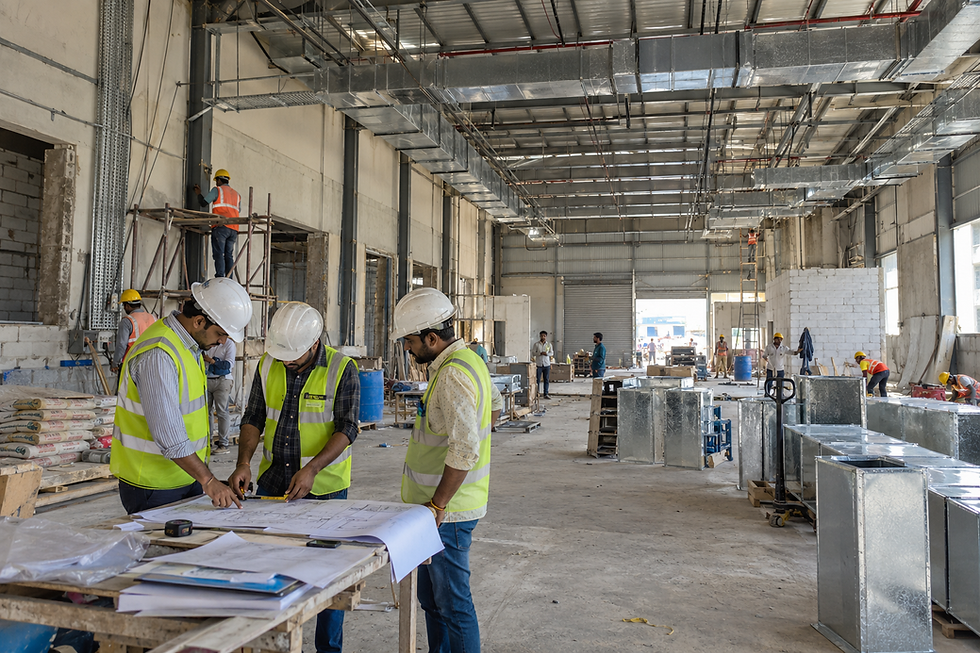
On projects like the Jagruti Rehabilitation Center in Ahmedabad — 33,000 sq ft, all trades running simultaneously over 100 days — coordinating safety across civil, HVAC, electrical, plumbing and interior teams is genuinely complex. The discipline that prevents a civil worker from walking into an active electrical zone, or an HVAC team from cutting into a slab without checking what's below it, comes from the routines above. Not from a safety poster.
The conversation continuing on LinkedIn
We posted a shorter version of these thoughts on our LinkedIn page today. The question we asked there: What is the one habit that changed how your site runs? If you work in construction and have an answer to that — something that actually shifted the culture on a site you've run — we'd genuinely like to hear it. The comments on that post are a good place to share it. Follow Sisco Profiles on LinkedIn at linkedin.com/company/sisco-profiles.
Talk to us about your project
Sisco Profiles provides turnkey civil construction, interior fit-out and MEP contracting for commercial and industrial projects across Ahmedabad, Vadodara and Bharuch. Own workforce. Single-point accountability from foundation to handover. Call or WhatsApp +91 99744 40304 or email projects.sisco@gmail.com.
Looking for expert interior fit-out services in Gujarat? Contact Sisco Profiles for false ceiling, glass partitions, MEP, and turnkey contracting across Vadodara, Ahmedabad, Surat, and Gujarat.
Explore our completed projects and our range of interior services to learn more about Sisco Profiles.
Looking for expert interior fit-out services in Gujarat? Contact Sisco Profiles for false ceiling, glass partitions, MEP, and turnkey contracting across Vadodara, Ahmedabad, Surat, and Gujarat.
Explore our completed projects and our range of interior services to learn more about Sisco Profiles.
Comments