


BOQ Estimation for Construction & Interior Projects in Ahmedabad & Vadodara: How to Stop Budget Overruns Before They Start

Updated: 5 days ago
Ask any contractor in Ahmedabad or Vadodara for a project estimate and you'll usually get a number within a day or two — a lump-sum figure per square foot, broken into three or four broad heads: civil, electrical, plumbing, finishing. It looks efficient. It is also the single biggest reason cost overruns are treated as normal on Gujarat projects rather than as a planning failure. A proper Bill of Quantities — BOQ — is a line-by-line breakdown of every material, quantity, and rate that goes into a project. Most quotations circulating in the market today are not that. They're educated guesses dressed up as estimates.
How BOQ Estimation Is Typically Done Today
On the majority of residential and mid-sized commercial projects across Gujarat, estimation still works backward from a target number. A contractor looks at the built-up area, applies a rate per square foot based on past projects of similar scale, and presents a total. Material quantities aren't measured from drawings — they're assumed from experience. Item-level rates aren't sourced from current supplier quotations — they're carried forward from the last project, sometimes with a flat inflation bump.
This works reasonably well when a project goes exactly as planned. It falls apart the moment anything changes — a design revision, a material substitution, a site condition the original estimator never saw. Because the estimate was never built from actual quantities in the first place, there's no way to isolate what changed and what it costs. Everything gets absorbed into a vague "extra work" bucket that shows up on the final bill.
Where the Numbers Go Wrong
The gap between a lump-sum quote and a proper BOQ shows up in predictable places:
Wastage factors that aren't accounted for — tile cutting, plywood offcuts, steel wastage at joints — all of which have industry-standard percentages that a rough estimate simply skips.
Rate escalation between quotation and procurement, especially on steel, cement, and hardware, where a 5-10% swing over a six-month project timeline is common and rarely built into the original number.
Provisional sums for items that weren't finalized at the time of quoting — sanitary fittings, modular hardware, false ceiling patterns — often carried at a placeholder rate far below what the client eventually selects.
Scope ambiguity between trades, where civil, MEP, and interior BOQs are prepared by different people without cross-checking, so items like chasing for conduits or make-good after plumbing work fall into a gap nobody priced.
Client-driven changes mid-project, which are impossible to cost fairly without a baseline BOQ to compare against — without it, every change order becomes a negotiation instead of a calculation.
What a Rigorous BOQ Process Actually Looks Like
A BOQ that actually protects a project budget is built in a specific sequence, not assembled from memory:
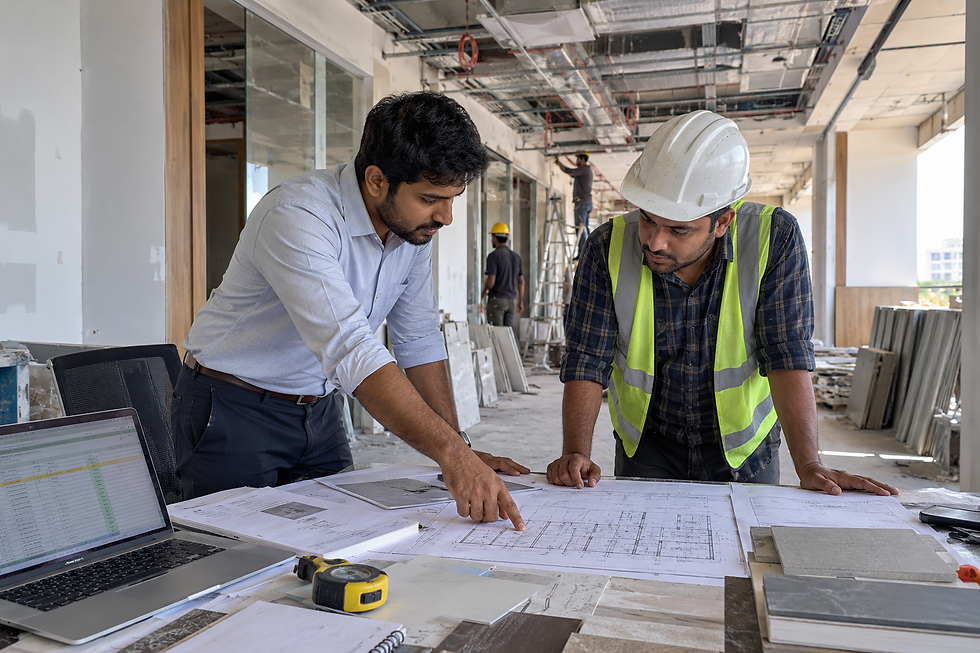
Quantity takeoff from finalized drawings — every wall, slab, door, window, and finish is measured from architectural and structural drawings, not estimated by eye. This is the step most Gujarat contractors skip or compress.
Item-wise specification, where each line specifies exact material grade, brand, and size — not just "flooring" but "800x800mm vitrified tile, Grade 1, [brand], anti-skid finish" — so there's no ambiguity about what was quoted versus what gets delivered.
Current market rates sourced at the time of estimation, cross-checked against at least two supplier quotations for major items like steel, cement, and modular hardware.
Wastage and contingency built in explicitly, at standard industry percentages per material category, rather than folded invisibly into a padded lump sum.
Provisional sums clearly flagged for any item not yet finalized, with a defined rate range and a note on when it needs to be locked before it affects the schedule.
A single consolidated BOQ across civil, MEP, and interior scopes, cross-checked for overlaps and gaps between trades before the client signs off.
Done this way, a BOQ isn't just a pricing document — it's a project control tool. Every change during execution gets measured against it, so a design revision produces a clear, itemized cost delta instead of a disputed round number at the end.
What to Ask Before You Sign a Quotation
Is this a lump-sum rate or a measured BOQ with item-wise quantities and rates?
Which items are firm and which are provisional, and what happens to the price when a provisional item is finalized?
What wastage and contingency percentages are built into the material quantities?
Are civil, MEP, and interior scopes priced together, with overlaps checked, or separately with gaps left unassigned?
How will a mid-project change be priced — against what baseline, and by whom?
Why This Matters More at Turnkey Scale
On a single-trade job, a rough estimate is a manageable risk. On a turnkey project — where civil, MEP, and furniture all move together on one timeline — an imprecise BOQ compounds. A gap in the electrical BOQ delays the ceiling trade. An underpriced hardware allowance forces a late-stage compromise on furniture quality. A missed wastage factor on tiling shows up as a shortage mid-installation, stalling the schedule while material gets reordered. The larger and more integrated the project, the more a properly measured BOQ pays for the time it takes to prepare.
Sisco Profiles prepares detailed, item-wise BOQs for civil, MEP, and interior scopes across Ahmedabad and Vadodara, before a single quotation is issued. If you're evaluating a project and want an estimate you can actually hold a contractor to, call Sisco Profiles at 9998730549 or visit siscoprofiles.co.in.
Looking for expert interior fit-out services in Gujarat? Contact Sisco Profiles for false ceiling, glass partitions, MEP, and turnkey contracting across Vadodara, Ahmedabad, Surat, and Gujarat.
Explore our completed projects and our range of interior services to learn more about Sisco Profiles.
Looking for expert interior fit-out services in Gujarat? Contact Sisco Profiles for false ceiling, glass partitions, MEP, and turnkey contracting across Vadodara, Ahmedabad, Surat, and Gujarat.
Explore our completed projects and our range of interior services to learn more about Sisco Profiles.
Comments